
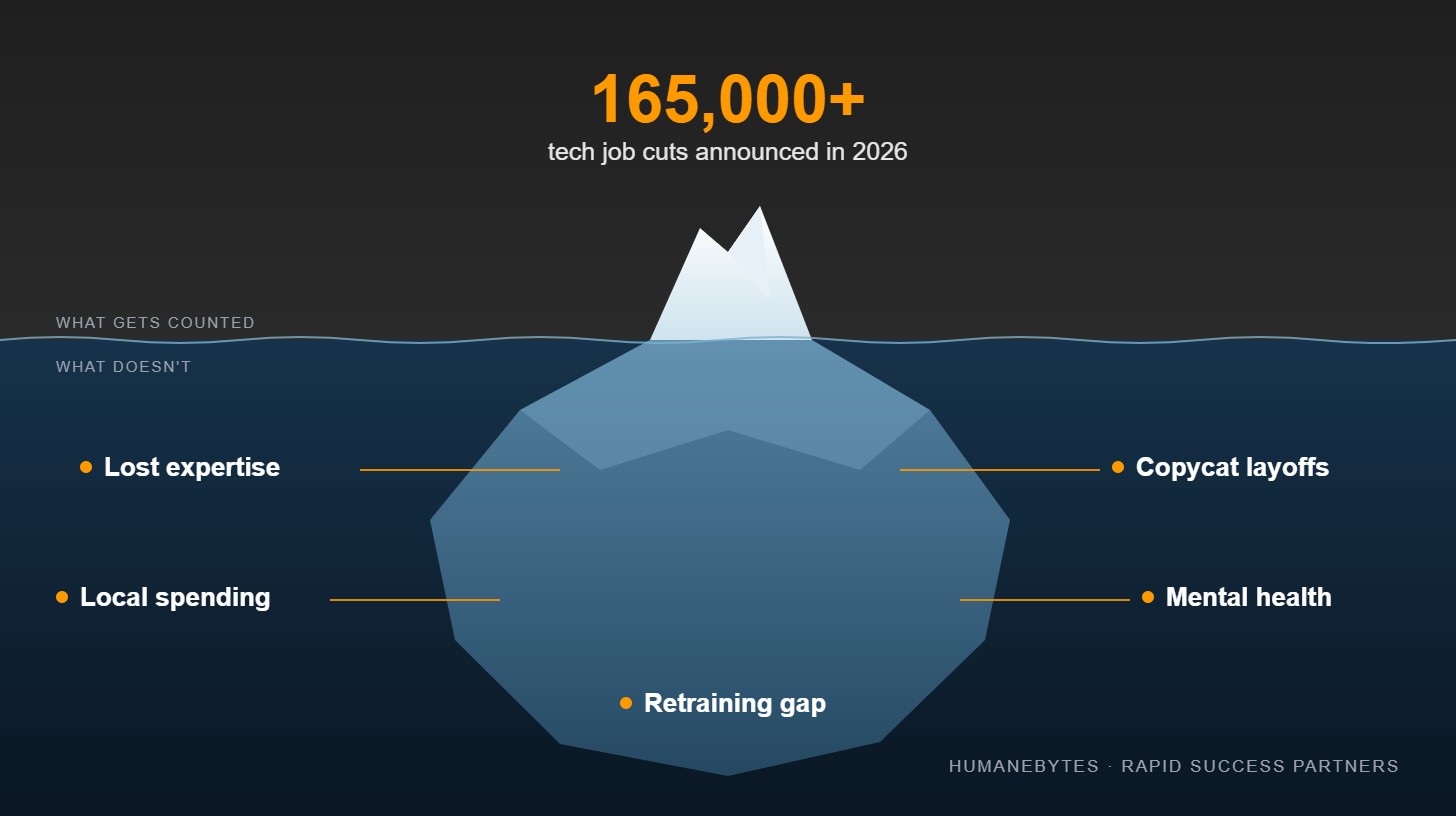
The headline number is striking on its own. U.S. tech employers announced more than 165,000 job cuts in the first nine months of 2026, according to Challenger, Gray & Christmas, already well past all of 2025. Some forecasters now warn that if the wave spreads into retail and finance, as many as 1.6 million more jobs could follow.
The number lands, people wince, and the conversation moves on to productivity gains and quarterly earnings.
What rarely gets counted is the toll building up underneath those figures. The cost of this shift isn’t measured only in lost paychecks. It’s measured in things that are much harder to quantify, and that difficulty is exactly why we keep ignoring them.
The visible number hides what’s actually being lost
When companies report layoffs, they report a headcount. They don’t report the institutional knowledge that walks out the door with each person: the engineer who understood why a legacy system was built the way it was, or the operations manager who spent a decade mapping every exception in the supply chain.
AI tools are remarkably good at pattern recognition and task automation, but they’re trained on documented knowledge. The undocumented knowledge, the judgment calls, the relationship nuances and the hard-won expertise that never made it into a manual, quietly evaporates.
This isn’t a romantic argument for preserving jobs regardless of economics. It’s a practical point about organizational risk that most companies aren’t accounting for. Every one of those 165,000 cuts represents expertise leaving the building, and the financial reporting records it as a cost reduction, not a knowledge-transfer problem.
The contagion runs deeper than one sector hitting another
The worry that layoffs will spread from tech into retail and finance is well-founded, but the usual explanation is straightforward: tech cuts reduce consumer spending, which pressures retail, which triggers more cuts.
What gets less attention is structural contagion. Industries watching tech use AI to cut costs will face investor pressure to show similar efficiency ratios. A regional bank or a large retailer that doesn’t show comparable “workforce optimization” starts to look like a laggard to shareholders, whether or not its business actually calls for that level of automation.
That creates layoffs driven not by real operational efficiency but by competitive signaling. The jobs eliminated in that second wave aren’t necessarily redundant. They’re sacrificed to a benchmark set in a different industry under different conditions, and the efficiency models never capture that cost because they assume every layoff is justified on its own terms.
Lost spending power erodes slowly, and that’s the danger
A sudden recession is traumatic and visible. Policy responds, relief kicks in and public attention concentrates.
A gradual, AI-driven displacement cycle is different and in some ways harder to fix. When tech jobs are cut over months, and retail and finance roles follow over the next several quarters, the drop in consumer spending stays below the threshold that triggers an emergency response, but above the threshold that quietly reshapes local economies.
Mid-sized cities with concentrations of tech employment are already feeling it. A software engineer’s or financial analyst’s paycheck funds restaurants, home renovations, local service businesses and school district tax bases. None of that secondary spending shows up in the layoff figures, yet communities absorb the loss without compensation or recognition. If displacement reaches the levels some forecasters warn about, the result could function like a recession while arriving too slowly to ever be called one.
The mental health toll has no line item
There’s now enough long-term research on job loss to treat its psychological cost as documented, not a soft concern. Prolonged unemployment, especially for people whose identity is tied to professional expertise, is linked to higher rates of anxiety, depression and stress-related illness.
The knowledge workers being displaced in this cycle often built their self-image around mastery and career progress, so the disruption cuts differently for them.
None of this appears in GDP estimates: the added healthcare burden, the lower productivity of employees who survived the cuts but now work under constant anxiety, and the lasting earnings penalty researchers consistently find for displaced workers even after they’re rehired. These costs are pushed onto individuals, families and public health systems while the efficiency gains land on corporate balance sheets.
Retraining rhetoric is outrunning retraining reality
Almost every announcement of AI-driven layoffs comes with a promise of reskilling and transition support. The gap between that language and what is actually funded and delivered is wide.
Real retraining for in-demand roles means meaningful credential pathways in areas where human judgment still matters, not a surface-level digital literacy course. That takes sustained investment, time and infrastructure that most companies aren’t providing at anywhere near the scale needed.
The people most affected are often mid-career professionals with real financial obligations and little runway for long retraining. Pointing them to a six-month coding bootcamp, when AI is compressing demand for entry-level coding too, isn’t a solution. It’s a way to look like you’re addressing the problem without paying to solve it.
What responsible leaders can measure now
If your company is considering AI-driven cuts, start counting what the headcount number leaves out:
- Knowledge at risk: Document the processes, exceptions and client relationships a role holds before you eliminate it.
- The real reason: Separate operational need from pressure to match another industry’s efficiency benchmarks.
- The people who stay: Track engagement, turnover and errors among remaining staff, not just payroll savings.
- Transition support: Fund retraining and placement that lead to real roles, and measure whether people actually land them.
The headline totals count paychecks. The real cost is everything they leave out. Businesses that want to lead responsibly through this period need to start measuring what they’ve been content to ignore.