
Most people who turn off chat history in an AI assistant assume their conversations go away fairly quickly. That’s a reasonable assumption. The switch is right there in the settings, and “history off” sounds pretty final.
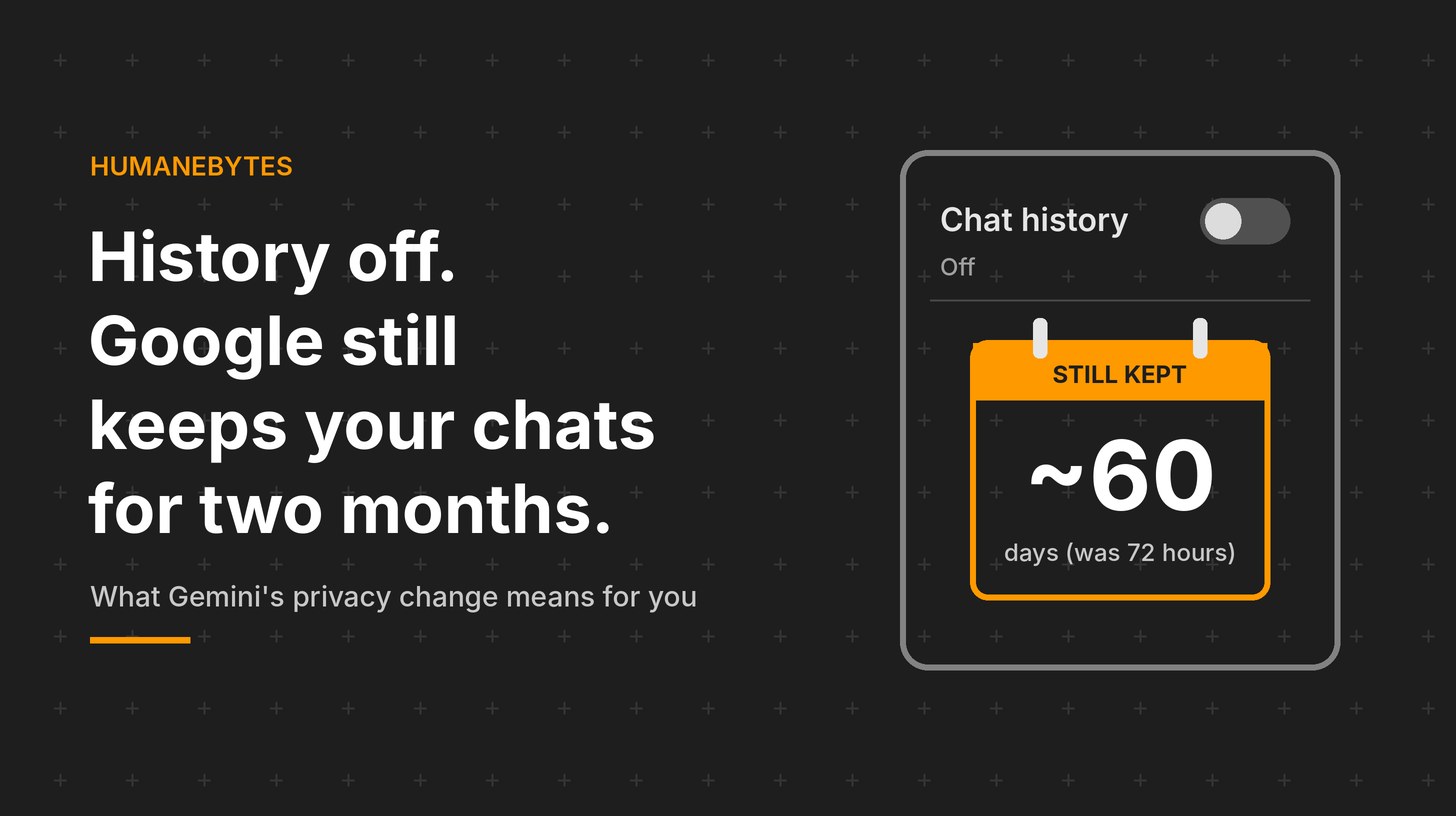
For Google’s Gemini, “fairly quickly” used to mean 72 hours. That’s changing. Google is extending how long it keeps chats made with history turned off, along with its temporary chats, to around two months. The change rolls out worldwide over the coming weeks.
Seventy-two hours to roughly sixty days is about twenty times longer. The switch didn’t change. What it means did.
What Google actually changed
Google laid out the update in its Gemini privacy hub and a blog post on November 16, and it’s notifying users by email. A few details matter:
- Chats with history off, and temporary chats, will be kept for about two months instead of 72 hours.
- Google says the longer window is for safety and security as AI systems get more capable.
- It applies to new chats going forward. It isn’t reaching back and keeping last week’s conversations longer.
- Conversations that get picked for human review can be kept much longer than that, as was already the case.
The good news that came in the same box
To be fair to Google, the update also fixes something people have complained about for a long time. Until now, one switch controlled both your chat history and whether Google could use your chats to train its AI. If you wanted to keep your history, you had to accept the training too.
Now those are two separate settings. You can keep your chat history and still tell Google not to train on it. That’s a real improvement, and it’s the kind of control people have been asking for.
It’s just paired with a longer memory for the people who chose to have the least remembered.
Why the label matters more than the number
This isn’t a story about a company breaking the law. It’s about the gap between what a setting sounds like and what it does.
When someone turns history off, they’re making a deliberate choice: keep as little of this as possible. Seventy-two hours already stretched that idea. Two months is a different thing entirely. And people tend to share more openly when they think a conversation is temporary. They ask about a health symptom, a money worry, a rough patch at home, a job they’re thinking about leaving.
Google says it uses these chats to run the service, handle feedback and protect users. Those are legitimate reasons. But any data that’s kept is data that can be breached, requested in a lawsuit, or quietly put to new uses down the road. I wrote more about that in what AI companies actually do with your data. Two months of someone’s conversations can say a lot about their worries, their habits and their plans.
How it compares
Gemini isn’t the only assistant that holds on to “off the record” chats for a while. But its new window is longer than the competition’s. ChatGPT keeps temporary chats for up to 30 days, and Claude’s incognito chats are kept for 30 days by default. Gemini went from the shortest window of the three to the longest.
In Europe, privacy law expects companies to keep only the data they actually need, and it will be interesting to see whether regulators think two months fits a “history off” setting. In the U.S., there’s no federal rule that forces the question.
What this means if you run a business
Here’s the part I’d worry about if I ran a small company. Plenty of employees use personal AI accounts at work, and some of them paste in client names, contracts, pricing or customer details. They may think “history off” protects them. It now means two months on Google’s servers.
A few practical steps:
- Write a simple AI use policy that says what can and can’t go into public AI tools.
- Use business accounts (like Google Workspace or an enterprise plan) where an administrator controls retention, instead of personal accounts.
- Keep customer and employee personal data out of consumer AI tools entirely.
- Remember that vendors you never think about can expose data too. A hotel check-in system that leaked a million IDs is a good reminder.
Choosing the right tools and setting sensible rules is a big part of the technology consulting we do. It’s much easier to do before something goes wrong.
What you can do today
If you use Gemini personally, watch for Google’s email, then open Gemini’s activity settings and set the two new switches the way you want them. If you’d like your history kept but not used for training, you can now do that. And for anything truly sensitive, the safest assumption with any AI tool is simple: if you wouldn’t want it on a server for two months, don’t type it in.
Trust is a lot cheaper to keep than to win back, and the settings people rely on should mean what they say. In the meantime, Gemini will now remember your “forgotten” chats longer than most of us remember where we parked.