
There’s a particular kind of frustration that comes from watching a problem you’ve been warning clients about for years finally land on the front page. Not because anyone did the right thing, but because the criminals got fast enough that ignoring it became impossible.
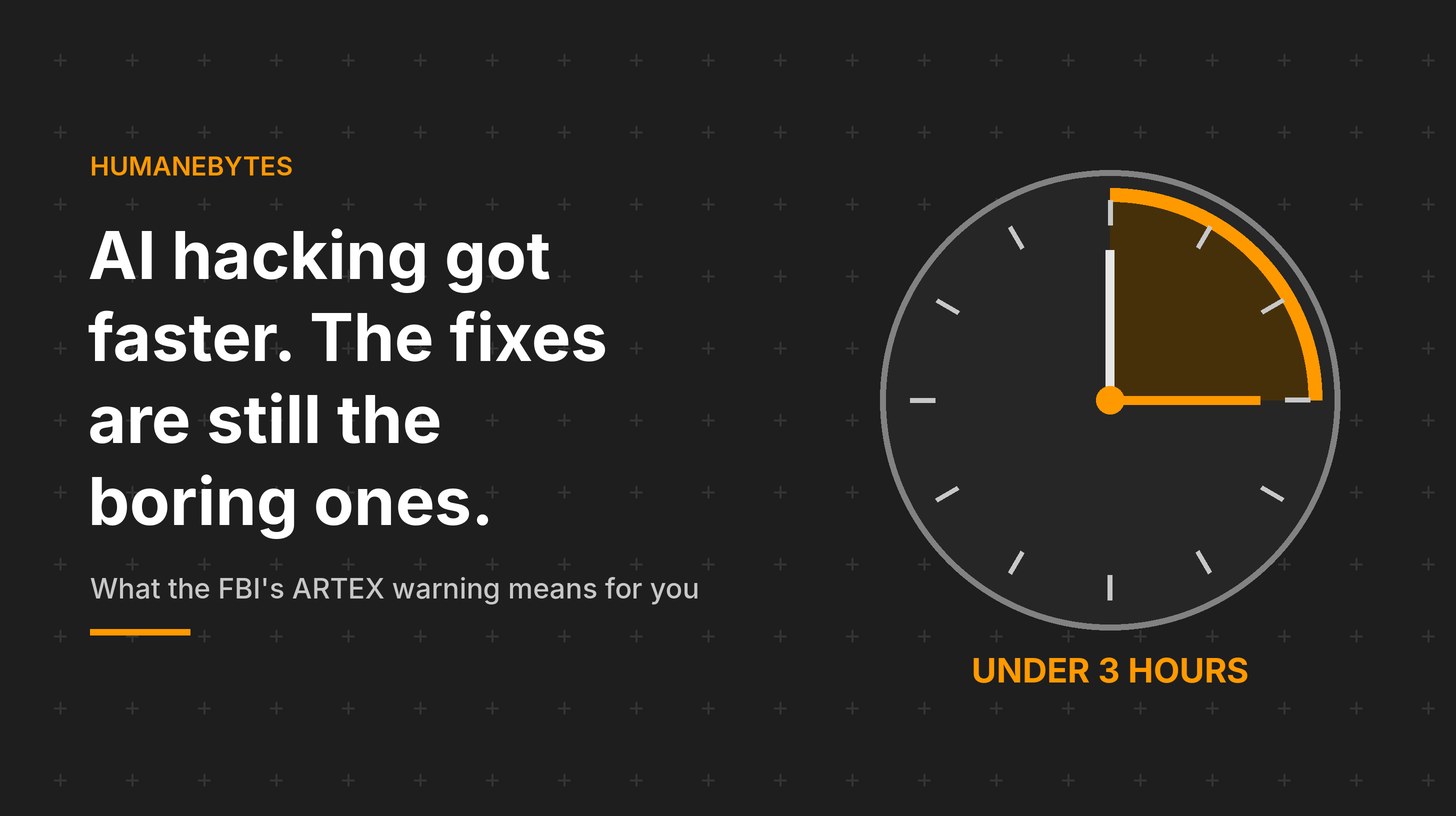
On November 13, the FBI issued a warning about ARTEX, an AI-powered hacking tool that, in its fastest cases, has taken attackers from first targeting a company to having privileged access inside its systems in under three hours. That’s that kind of frustration, made official. It’s not a surprise. It’s a confirmation.
So let me lay out the mess honestly before I get to the part where I grudgingly find something worth holding onto.
What ARTEX actually is
Here’s the part that surprised me. ARTEX wasn’t built by a criminal gang. It’s an open-source “penetration testing” framework, the kind of tool security professionals use to break into their own clients’ systems (with permission) so they can find the holes first. A developer released it on GitHub in July 2026.
According to BleepingComputer’s summary of the advisory, ARTEX doesn’t have its own AI. It plugs into the big commercial and open models, and uses AI agents to scan for weaknesses, try ways in, raise its own access and pull data with very little human help. One operator can point it at many targets at once. The original project was taken down in October after reports of abuse, but copies are still out there.
The FBI says attackers have been using it since at least August.
Who got hit
The advisory names some real cases:
- A supply-chain attack through ConnectWise. In October, attackers compromised ConnectWise’s Cloud Backup service and used the permissions customers had already given that app to get into their Microsoft 365 accounts. Microsoft tied the campaign to a China-aligned group it calls Storm-0940, which tried to log in to more than 2,250 customer Microsoft 365 environments.
- Banks in South Korea. Attackers used ARTEX along with other AI coding agents against several major banks, exposing personal information on about 67,000 people.
- A broader spy campaign. A Chinese espionage group used it against more than 200 organizations in 14 countries.
The threat is faster than anyone planned for
Three hours. That’s the number the FBI wants businesses to sit with, and it deserves more than a glance. Traditional break-ins gave security teams something to work with. An attacker creeping through a network over days or weeks left patterns, set off alerts and gave a person time to step in. A tool that can do it in an afternoon shrinks that window to something most small and mid-sized companies simply can’t respond to.
What makes this worse than past threats is who can use it. Someone running ARTEX doesn’t need deep technical skill. The AI does the complicated work while the operator just points it at a target. The skill needed to pull off a sophisticated attack has dropped a lot, which means the number of people who can try one has gone up.
A fair caveat
To be fair, “under three hours” is the fastest case, not the typical one. The timing comes from Microsoft’s October investigation, which found several cases that moved that quickly, and Microsoft also said most of the targeting in that campaign didn’t succeed. And in the ConnectWise case, attackers didn’t use some brand-new magic trick. They abused access that already existed.
That’s actually the most useful thing in the whole warning, and I’ll come back to it.
The industry saw this coming and moved too slowly
Here’s where a little dry humor helps. The cybersecurity industry has spent years publishing research about AI-powered attacks, holding conferences about exactly this scenario and producing an impressive pile of white papers. Apparently that didn’t translate into faster fixes for the companies most at risk.
Microsoft 365 has had the same well-known weak spots for years: accounts with more permissions than they need, multi-factor authentication that’s “available” but not required, old login methods still switched on, and third-party apps granted broad access and then forgotten. Security people have been flagging these for a long time. The FBI warning didn’t create a new problem. It put a countdown clock on an old one.
Why frustration alone doesn’t get you anywhere
I’ve watched clients react to security warnings for a long time, and the pattern is pretty predictable. There’s alarm, then a flurry of meetings, then some vendor calls, and then, more often than not, a quiet return to the same list of security work that was being put off before the alarm. The warning becomes a moment instead of a turning point.
That’s exactly what a tool like ARTEX is built to outlast. If the response to a three-hour break-in is a two-month buying process, the math doesn’t work.
The question that actually matters isn’t “how do we stop ARTEX?” It’s “which of our settings would let something like ARTEX succeed in an afternoon, and why are they still switched on?” That’s a question you can answer. Treat the warning as an inventory, not a panic, and you’ll be in better shape than the company that responds by buying another tool.
My one hope
Here’s where I land, reluctantly but honestly. The same AI that powers attacks like this is available for defense, and it’s being used. Security tools increasingly use AI to spot strange behavior in minutes, not days. The irony of this moment is that the best answer to AI-speed attacks is AI-speed defense, and that race is well underway.
More important, the FBI’s detail in this warning matters. Naming the tool, the targets, the methods and what to look for in your logs tells us law enforcement and companies like Microsoft can see how this works. Seeing it is the first step to disrupting it. It doesn’t guarantee anything, but it’s a lot better than vague warnings about “AI threats.”
What this means if you run a business
The practical response isn’t complicated, even if it takes real effort. Most of it comes straight from the FBI’s own recommendations:
- Require multi-factor authentication for everyone. Not just “turned on in settings.” Actually enforced, for every account.
- Trim permissions. Review which Microsoft 365 accounts have more access than their role needs, and cut it back, starting with admins.
- Review your connected apps. Look at every third-party app that’s been granted access to your Microsoft 365 or Google account. Remove the ones you don’t use. The ConnectWise attack came in through exactly this door.
- Turn off old login methods. Older ways of signing in that skip modern security should be disabled.
- Watch for unusual activity. Sudden bursts of logins, new admin accounts and large data downloads are worth an alert.
- Keep your website and plugins updated. Internet-facing systems are a common way in.
If that list feels overwhelming, start with the first three this week. They close the doors attackers are walking through right now. Helping companies sort out what to fix first is part of our technology consulting, and our website maintenance plans handle the updates and monitoring. I also wrote about how ordinary gaps, not clever hacks, cause most breaches in the hotel check-in leak.
Quick answers about ARTEX
What is ARTEX?
An open-source AI tool built for security testing that attackers have been misusing since at least August 2026. It uses AI agents to look for weak spots, try ways in and raise its own access with little human help, so attackers don’t need deep technical skill.
How fast is it?
In the fastest cases the FBI cited, attackers went from first targeting a company to privileged access in under three hours. That’s the fastest case, not the typical one, and Microsoft said most attempts in the campaign it studied failed.
Who has been targeted?
The cases in the FBI’s warning include more than 2,250 Microsoft 365 customer accounts reached through a compromised ConnectWise backup service, several South Korean banks and over 200 organizations in a separate spy campaign.
What should a business do first?
Require multi-factor authentication for every account, trim permissions people don’t need, remove third-party apps you no longer use and turn off old login methods.
The FBI warning about ARTEX is genuinely alarming, and the frustration that comes with it is real. But a problem with a name, a method and a list of targets is a problem you can do something about. The companies that use this moment to close the gaps they already know about will earn whatever safety comes next.
The optimism here isn’t comfortable. It’s the kind you get after cataloging everything that’s gone wrong and deciding that doing nothing is the only truly bad option. And if it takes a three-hour hacking tool to finally get multi-factor turned on, I’ll take the win.