
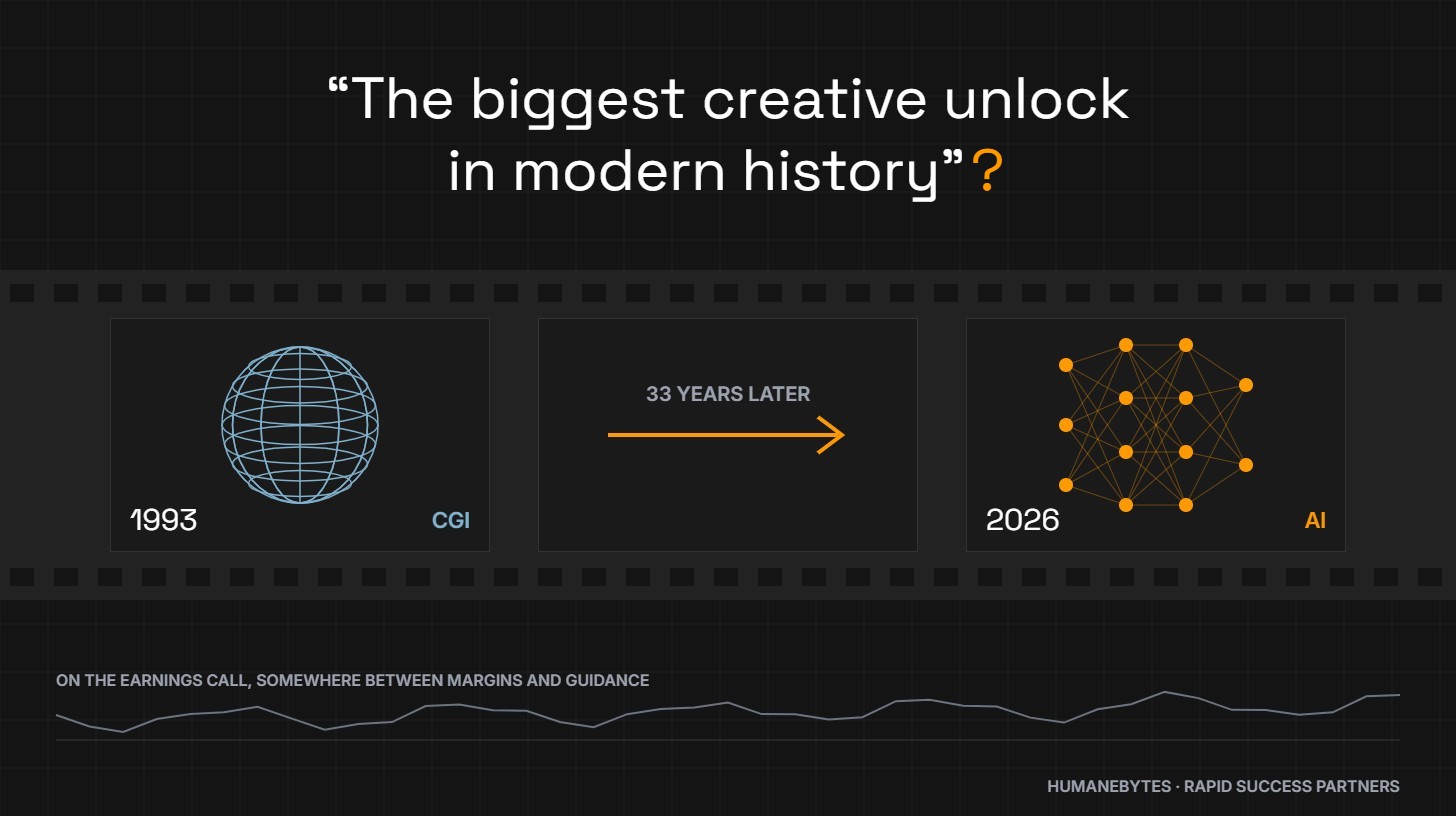
There’s a moment in every earnings call when someone says something that, anywhere else, would stop a room cold. On Paramount Skydance’s latest call, CEO David Ellison delivered his. He said AI “really has the potential to be the biggest creative unlock in modern history” for the film business, bigger even than CGI. The response from the analysts on the line was, more or less: noted, next question.
That’s worth a pause. Not because Ellison is wrong, but because we’ve apparently reached the point where predicting that a technology will reshape human creativity more than anything in decades is a routine data point, filed somewhere between subscriber growth and operating margins.
The claim is enormous, which is why it’s odd that it sounded routine
CGI didn’t just change how movies looked. It changed what movies could be. Before it, a story could only show what someone could build, photograph or paint by hand. After it, those limits fell away. The dinosaurs in Jurassic Park, the liquid-metal villain in Terminator 2, the whole virtual world of The Matrix: none of those stories could have been told the way they were without it. The industry has spent about three decades absorbing that shift, and it’s still at it.
Ellison pointed to those same films himself, then said “it’s hard to imagine that AI is not going to have a more significant impact.” He didn’t say it as a provocation or a manifesto. He said it the way you’d walk investors through next summer’s release slate.
Hollywood is having an existential conversation and calling it strategy
Every industry is wrestling with AI, so that part isn’t news. What’s different is what studios are wrestling with. They aren’t asking whether AI will tidy up procurement or speed up the supply chain. They’re asking whether it will change storytelling itself, the very thing studios exist to do, and they’re presenting the answer as a growth opportunity.
Film runs on human imagination. Writers dream up characters, directors make a thousand small choices, actors bring emotional truth to a scene with their own faces and voices. The machinery around all that is huge and expensive, and AI may well make it cheaper and more capable. But Ellison didn’t call AI a production efficiency tool. He called it a creative unlock. That puts creativity at the center of the claim, which means the real conversation isn’t about faster visual effects. It’s about what happens to authorship when some of the creating isn’t done by a person.
The CGI comparison cuts both ways
It matters who’s saying this. Paramount Skydance is a company in the middle of a big transition after the merger that reshaped its ownership and leadership. Ellison isn’t a legacy studio executive; he arrived with a reputation for rethinking how studios work. So the CGI comparison isn’t just a history lesson. It’s a signal about where he plans to take the company.
And CGI history comes with a footnote. The same technology that gave us wonders also gave us years of movies that mistook technical capability for storytelling and swapped spectacle for meaning. CGI never guaranteed better films. It guaranteed different films, some magnificent and some best forgotten. If AI is the next CGI, that part of the story comes along too.
Nobody on the call seemed to find this remarkable
This may be the most telling detail of all. A CEO made a claim about transforming human creative expression, in an industry built on that expression, and it landed like an ordinary update. From what’s been reported, nobody pressed him on what it means for a studio to call AI a creative unlock when its writers and actors went on strike in 2023 over exactly these questions. The call moved on.
I don’t blame the analysts. Their job is the numbers. But it says something about the moment we’re in. The biggest possible claims about AI have become, through sheer repetition, unremarkable. When something that would have sounded like science fiction five years ago gets delivered in a flat corporate tone and received without a raised eyebrow, that tells you how fast the ground has moved.
What “biggest creative unlock in modern history” actually means
The phrase is specific enough to sound bold and vague enough to be safe. If AI transforms filmmaking over the next decade, it will look prescient. If it doesn’t, it’s soft enough to fade quietly from memory. That’s normal for earnings calls. What isn’t normal is the subject: imagination, and the very human work of making stories that matter to other humans.
Ellison may be entirely right. AI may help tell stories none of us have dreamed up yet, and I hope it does. I’d just like somebody to raise a hand the next time a CEO predicts the future of human imagination somewhere between the margin guidance and the Q&A.
In the meantime, I’ll keep rewatching Jurassic Park every few years. It still holds up, and those dinosaurs were made by people who argued over every frame. That’s the part I’d like to keep.